

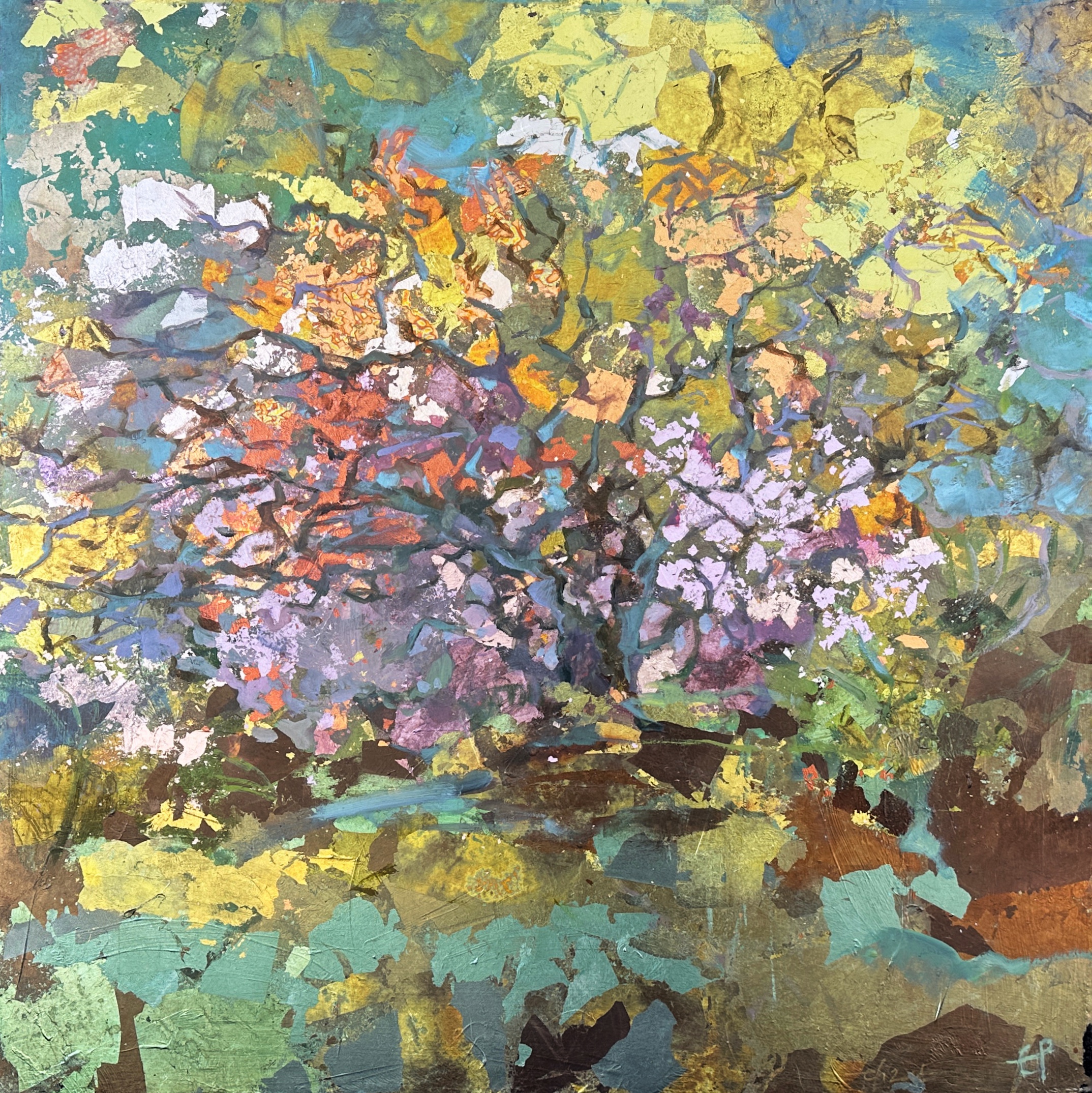
Ironwood
30 x 30 in; gold leaf, dyed silver leaf, oil paint on wood

I — Action Before Alignment
I began with a vivid image of light breaking through ironwood leaves at sunset.
The underpainting was more detailed than usual. I developed the sky further than I typically would, planning to leave the painting sky exposed to explore contrast between oil paint and leaf.
When the first layer of leaf went down, the surface glowed immediately.
The tree shape, however, was not yet articulated.
I could not see how to define it.
So I began painting.

From
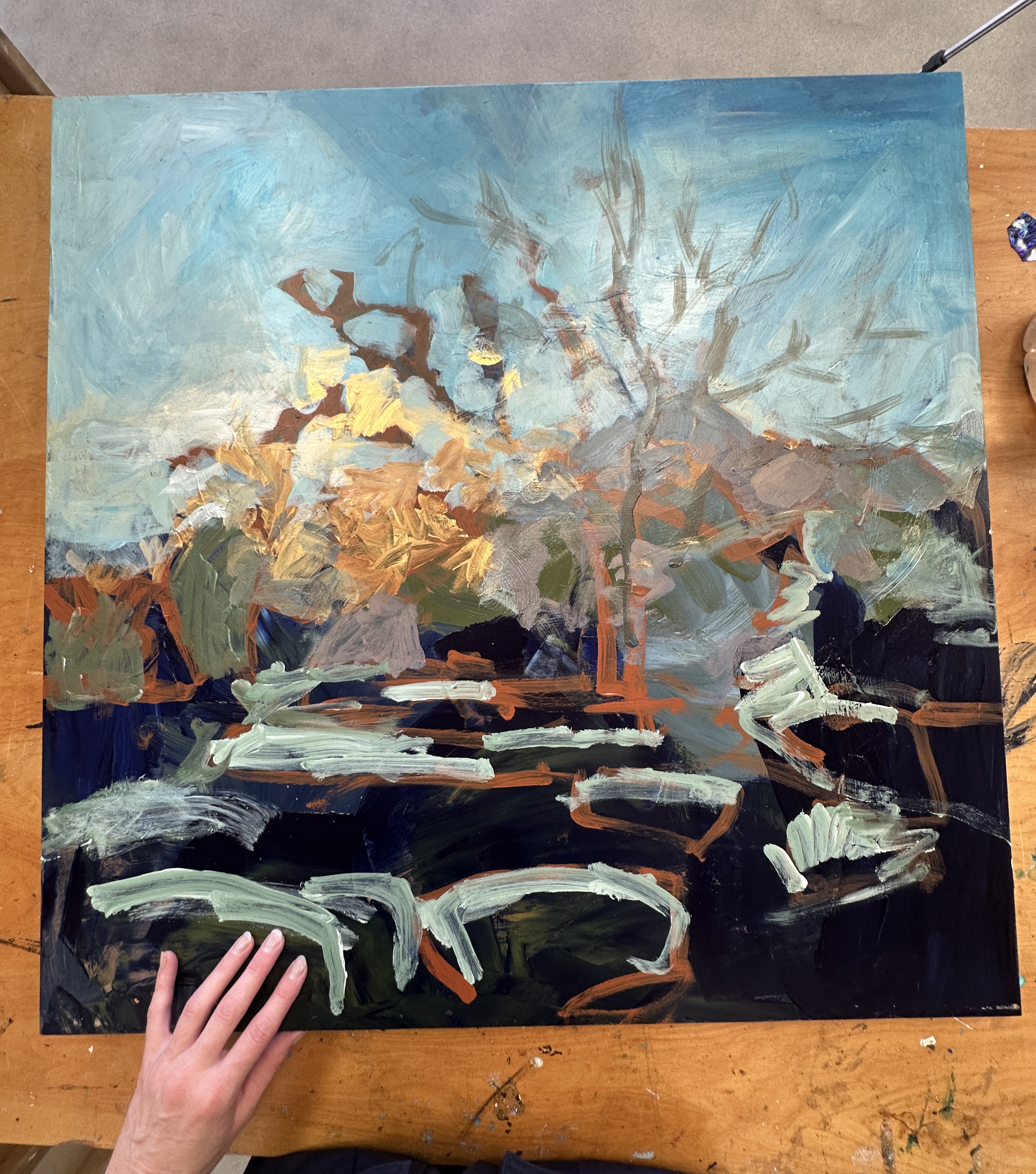
Developed underpainting. Sky painted, with loose mountains and green bushes, some yellow into the leaves. Tree branches laid in. Structure energetic and open.
Toward

Leaf applied. Tree trunk and some branches painted in to create definition, though still without weight or shape. Most of the leaf painted over and vibrant reds and oranges eliminated.
Turning Point

The moment after the first layer of leaf. Glowing and atmospheric. The structure was suggestive, not incomplete.
Integration
After the first layer of leaf, (see: the point of shift) the surface was already luminous and held the original intention fully.
It was a perfect place to pause.
But I could not see how the tree would emerge from it.
Instead of waiting, I defined it.
Branches were painted in. More leaf was added. Adjustments multiplied — not because the structure was wrong, but because I was uncomfortable not knowing the next step.
The issue was not composition.
It was timing.
I mistook temporary blindness for structural failure.
And I acted before perception had settled.
That decision set the tone for everything that followed.
Ironwood
I — Action Before Alignment

II — Overcorrection
After the first layer of leaf, I continued working in search of resolution.
More lines were added to define the branches.
More color was layered in paint and leaf to restore atmosphere.
It was a tree.
But with each adjustment, the original clarity weakened.
The tree became more articulated — and less coherent.
The more I painted, the less visible the concept became.
From

The tree was defined. Patches of green, pink, and yellow sky filled the spaces between branches. Light remained — in leaf and paint, but hierarchy was unstable. The right side lacked structure.
Toward

As paint accumulated, luminosity diminished. The surface thickened. Original concept - light breaking through leaves- now completely lost.
Turning Point

Painting over and re-leafing the section further obscured the image.
Integration
Clarity in a painting is perceptible — even mid-process.
This was no longer clear.
I was no longer responding to what was present.
I was reacting to what I believed was missing.
Effort increased.
Coherence decreased.
Each layer meant to fix the image pushed it further from the original impulse — light breaking through leaves.
The problem was not a lack of work.
It was action without alignment.
This was the first moment I knew it required distance.
Ironwood
II — Overcorrection
III — Reset Through Clarity
The image was lost from repeated correction.
Light was buried.
On October 7, I spray-painted across most of the surface.
The mud disappeared.Color simplified.
I paused.
Weeks later, I returned and re-leafed almost the entire painting.
Much of the previous work remained beneath it — softened, atmospheric.
From

A tree nearly split; on the right branches painted, on the left pieces of muddy sky obscure the light.
Toward

Leaf returned across almost the entire surface. Previous layers remained faintly atmospheric beneath it. Luminous again — without forcing detail.
Turning Point

The accumulated effort was erased. The surface flattened to a single field. Atmosphere returned.
Integration
This reset was deliberate.
It was not reactive. It did not invent a solution.
It cleared the interference.
Spray paint removed the accumulated effort and simplified the field.
And, I did not rush to resolve it.
When I returned weeks later, I allowed the leaf to carry the image again. Much of the previous work remained beneath it — softened, atmospheric, integrated.
The tree began to suggest itself through contrast and atmosphere.
It was not far from where I had found myself after the very first layer of leaf— before paint.
The difference was not material.
It was perceptual.
Only then could I see what had already been possible.
Ironwood
III — Reset Through Clarity
IV — Resolution with Restraint
After re-leafing the surface, the painting was luminous again.
Some of the previous work remained beneath it — softened, atmospheric, integrated.
The image was not far from where it had been weeks earlier.
This time, I was not trying to achieve anything specific.
I walked past the ironwood tree at sunset, watching light fracture through the branches.
It was not a fixed image.
It was movement.
I returned to the painting with that in mind, feeling I had already achieved it.
From

The surface was luminous and open. Structure was present without force.
Toward

Branches were gently defined. Concept clarified without tightening the surface.
Turning Point

Tree branches painted only subtly; just enough to suggest without making it overly literal. Room for the light and eyes to move.
Integration
The painting did not need reinvention.
It needed restraint.
Earlier, I had tried to define the tree — to make it recognizable, specific, correct.
This time, I stopped measuring it against a literal ironwood.
I returned to the experience instead — the way light fractures through branches at sunset, the way it blinds and reveals at the same time.
The branches were painted only enough to anchor the subject as tree.
The leaf carried the rest.
The shapes are not fixed.
They suggest themselves.
As you move around the piece, the light shifts.
The image unfolds.
Ironwood resolves not through precision —
but through making space for perception, my own and yours, to happen.
Ironwood
IV — Resolution with Restraint
Watch the making of
Ironwood
The entire process — from first mark to final surface — distilled into four minutes.
You're part of this
The work doesn't happen in isolation — what you notice becomes part of how it evolves. Tell me what's moving you, what a piece opened up, what you're sitting with. I read every one, and they shape what comes next.