

Horizon
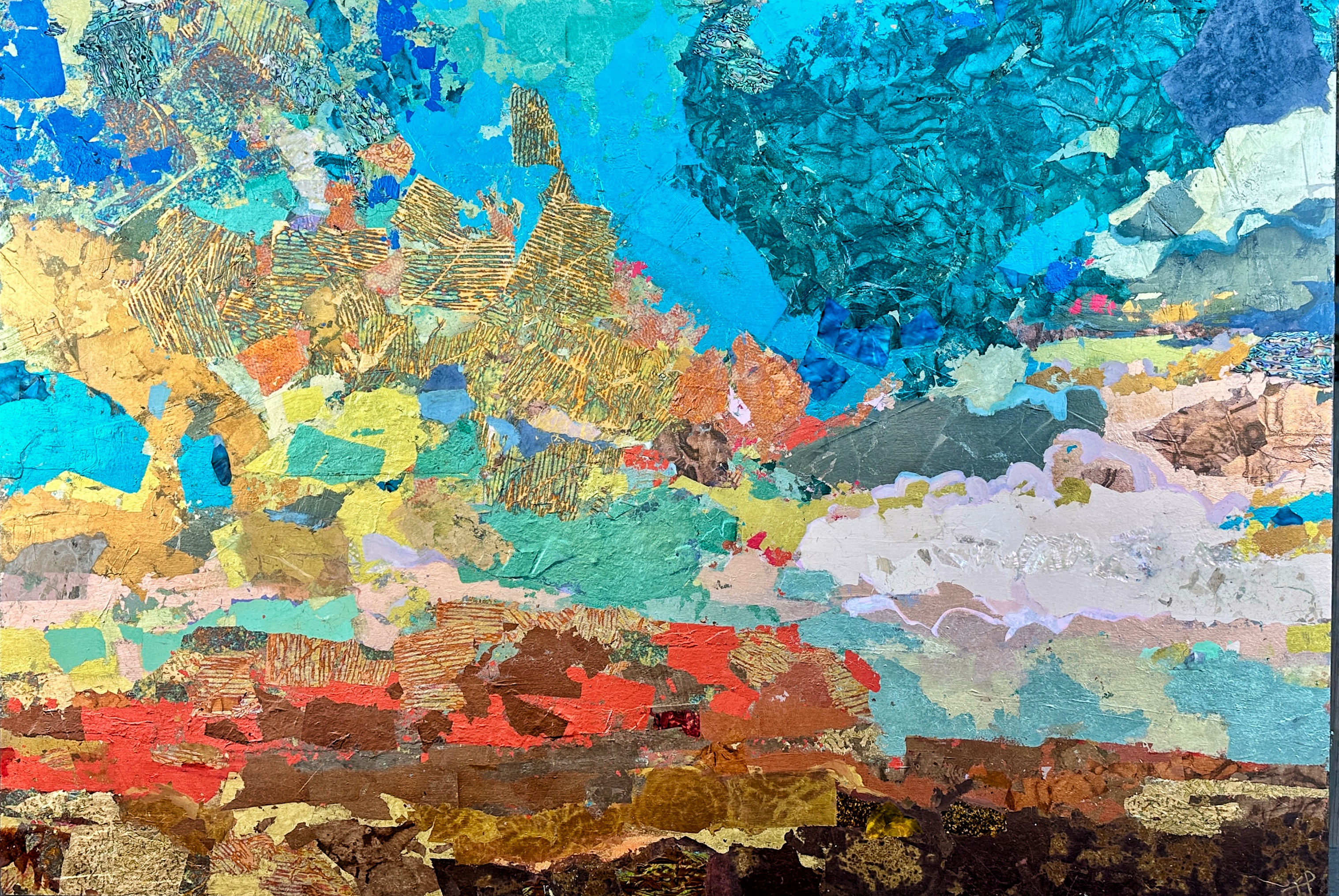
40 X 60; oil, gold and silver leaf, mother of pearl, paper, abalone shell, on wood panel. How Horizon became "Grounded into the Infinite"

I - The Weight of Certainty
Before the first mark, I had a vision put to paper- a sketch of what I knew it would become.
The scale was decided first. This would be a big sky piece with a table of mountains. The sky would be geometric and overhanging. The land low.
I was studying hard edges — long, linear mountain plateaus and chunky abstracted clouds. Red-orange and blue dyed silver leaf were at the core of the color story. I build the concept from the strength of tension between those colors.
For the first time, I created a small, paper sketch. Then a painted study. Then three additional small studies in leaf — testing color relationships and weight.
The structure was not being discovered.
It was being built.

From
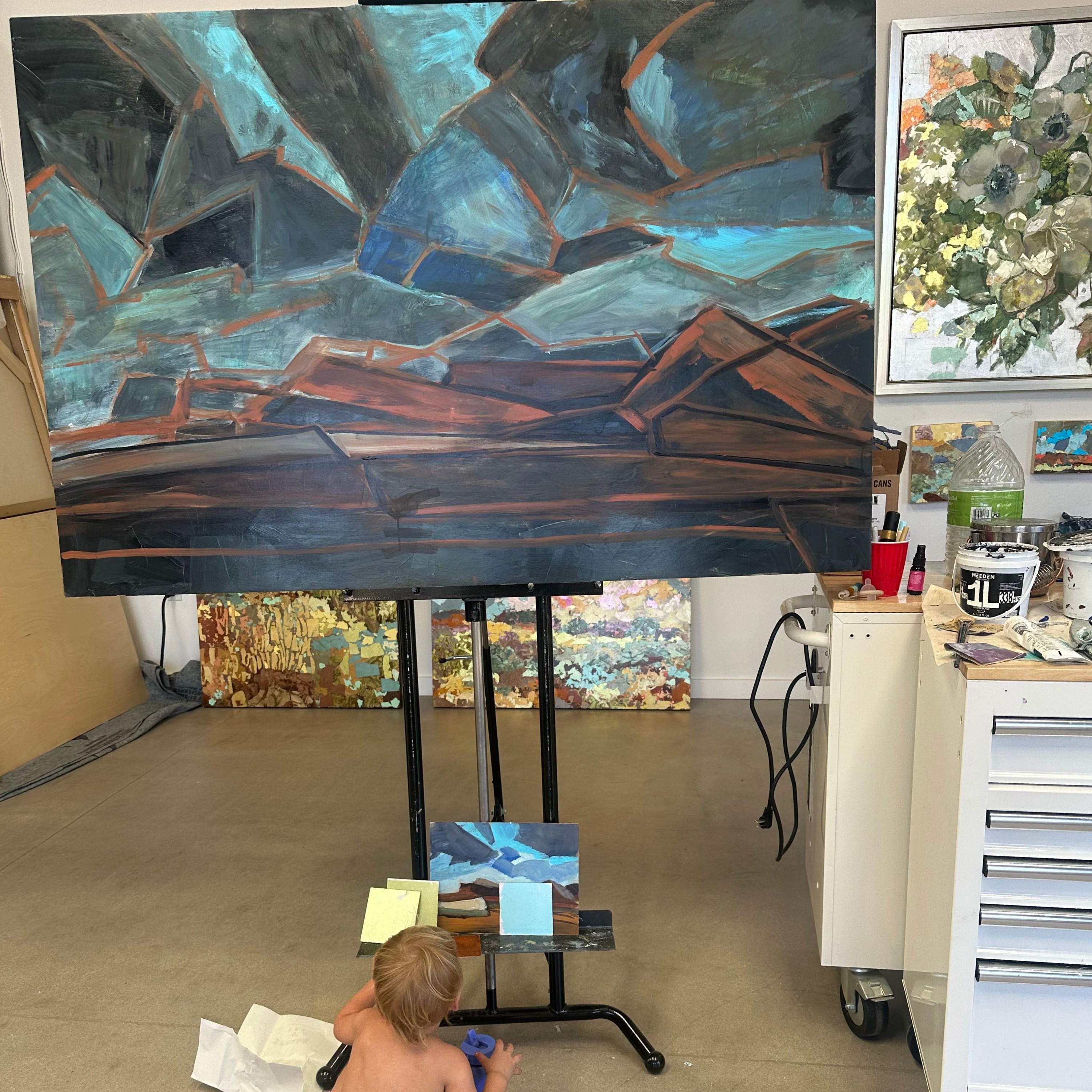
The composition was decisive.
Angular lines and stacked mountains anchored the base. The sky was delineated like with a chisel, made to carry emphasis. Big, bold shapes.
Toward
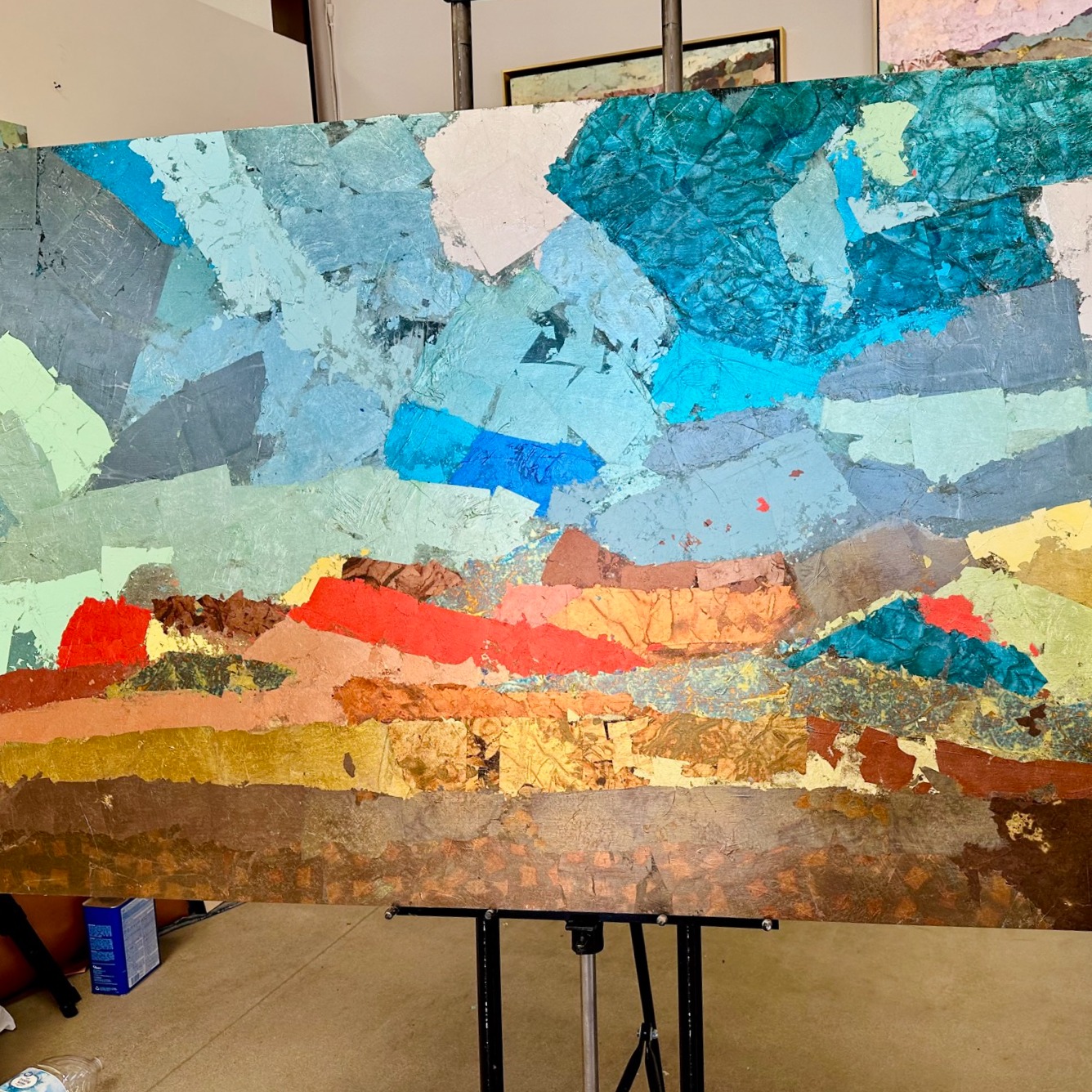
Once the leaf was applied at scale, the composition tightened.
The lines were exact, the shapes came out as planned, but the openness I anticipated did not expand with the size.
Turning Point
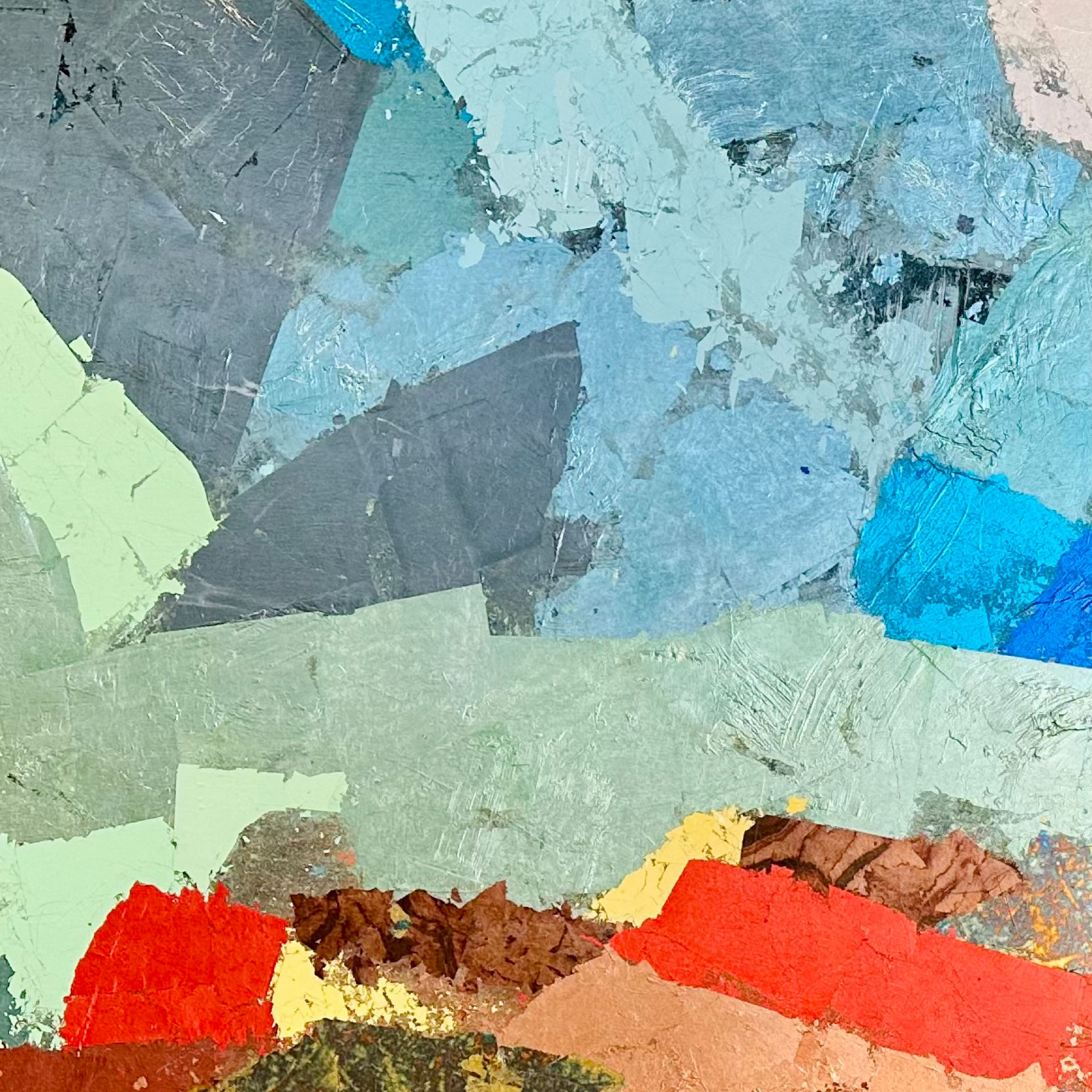
The angular cloud forms held precision and interest.
But instead of opening the sky with depth, they compressed it.
Integration
The geometric sky shapes translated from the smaller studies and the underpainting exactly as designed, but it did not translate spatially.
At such a large scale, the structure became restrictive. The leaf carried visual weight, but not atmosphere.
The composition held — but it did not breathe.
What I mistook for clarity was actually compression.
The rigidity in the structure mirrored my rigid expectation.
I had decided what it should be before I could see what it was.
Horizon
I - The Weight of Certainty

II - Beginning A Long Return
Returning from Mexico, color feels alive again. Texture feels rich. I want to bring that openness back into Horizon.
The small studies had felt electric — like something new was happening. When I scaled the idea up to 40 x 60, I expected that same spark to expand.
When the gold leaf went down, it didn’t translate.
The geometry was intact. The palette remained bold.
But the atmosphere collapsed.
The scale demanded more than I had anticipated.
There is still excitement.
There is still openness.
But there is weight in the surface.
From
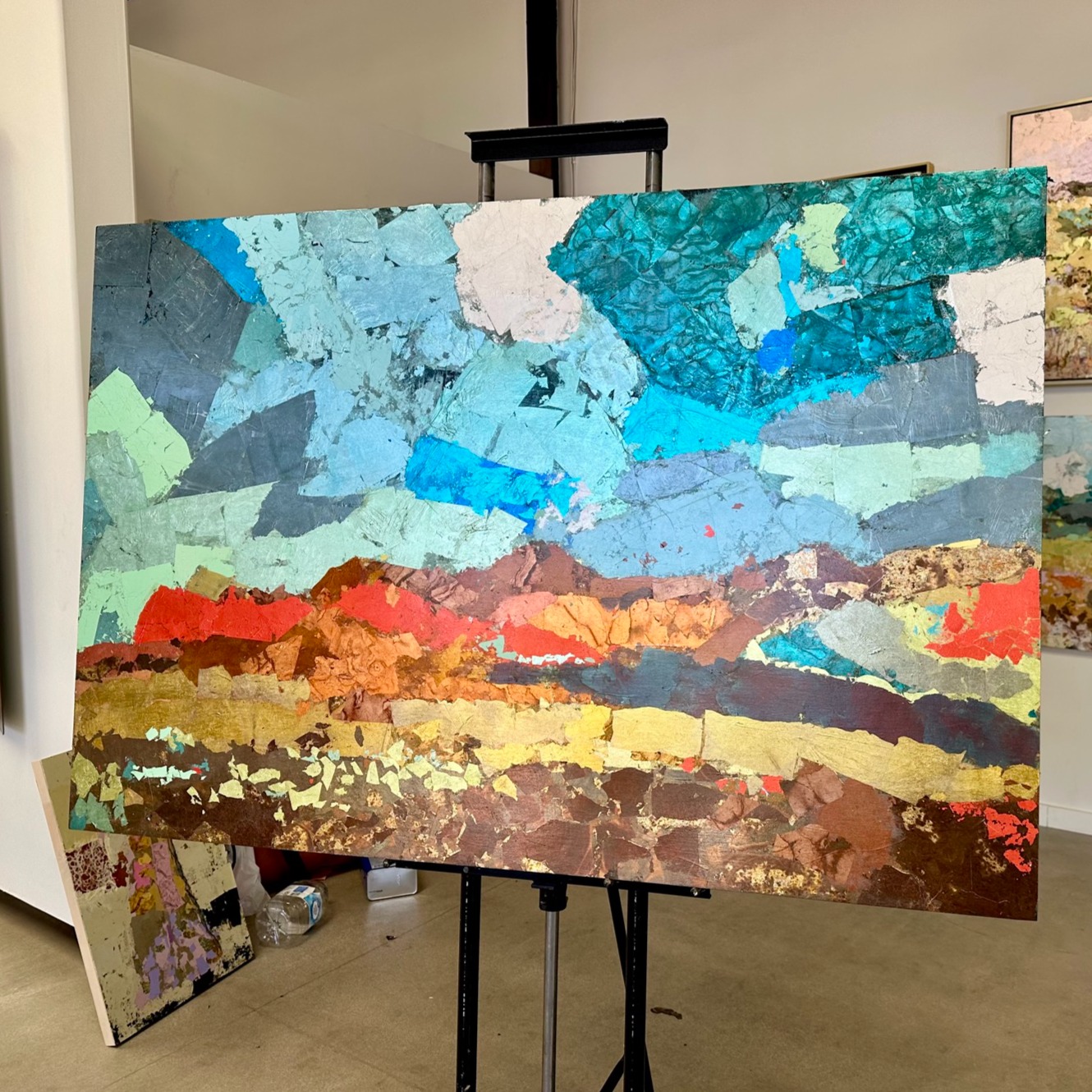
The sky remains structured and declarative.
Hard edges hold the composition in place. The intent is still fixed.
Toward
One edge in the clouds softens. More leaf enters. Paper is tested but not committed to.
The sky becomes slightly more billowy. Some red is removed. It is softer.
The surface shifts — but the compression, and confusion in the foreground, remains.
Turning Point
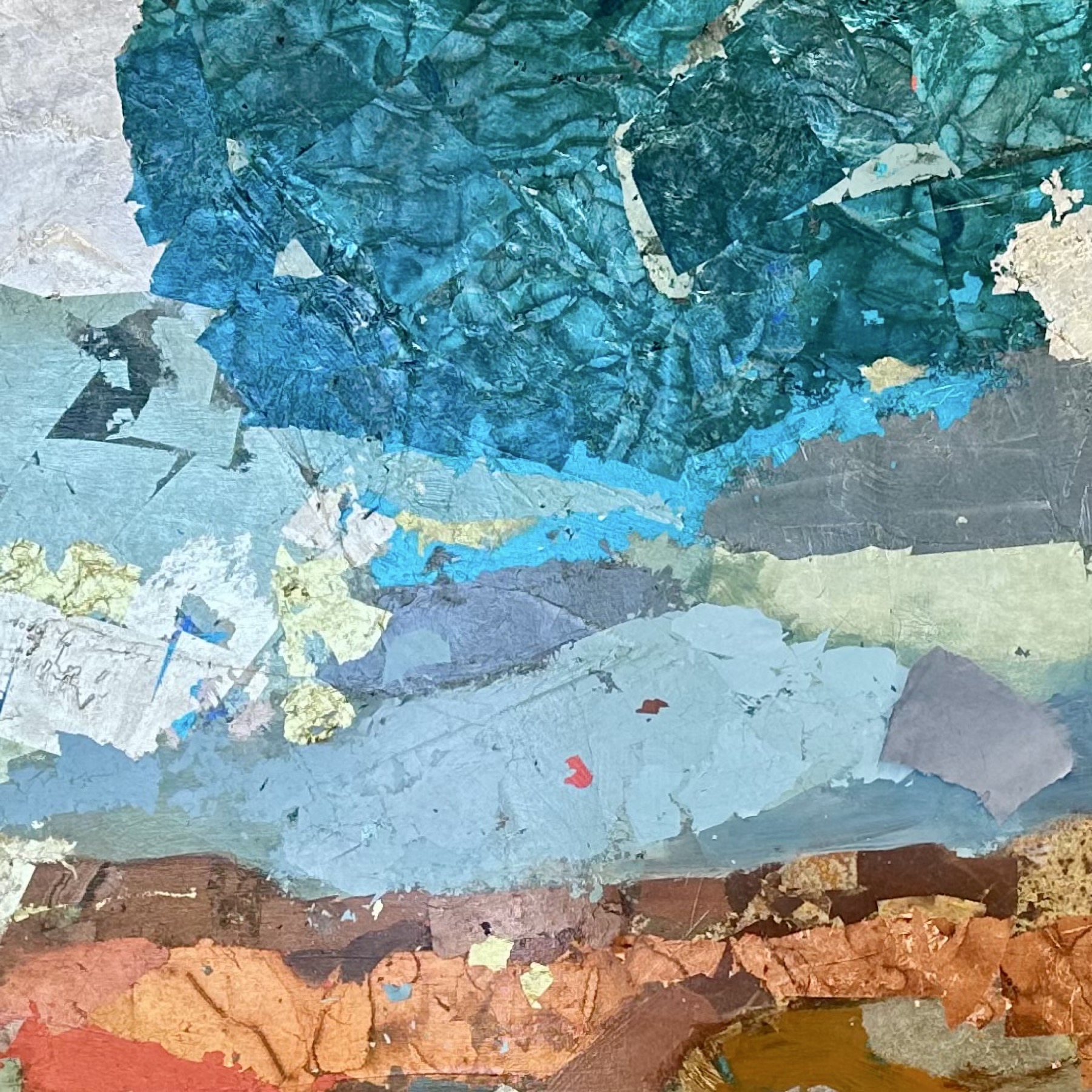
The first intentional softening occurs here.
An edge relaxes. The form becomes less rigid.
The structure loosens slightly — without fully releasing control.
Integration
Listening back, I can hear the optimism in my voice.
I speak about openness and breathing room.
But the painting was still heavy.
I had already named expectation as a problem — yet I was still committed to the idea of it’s bigness.
Big. Bold. Monumental.
That commitment continued to direct the composition.
Softening the edge improved the surface.
It did not yet resolve the lack of depth and atmosphere overall.
The return had begun — but it was still partial.
I was speaking about openness, but I was still seeing through expectation.
The surface softened. My perception had not. I still couldn’t see.
Horizon
II - Beginning A Long Return
III — Enjoying the Becoming
The original structure remains intact.
Leaf dominates the surface. The sky still follows the earlier geometric plan — angular, controlled, defined. The foreground has begun to fragment, but the primary composition has not yet shifted.
No new materials are introduced.
Instead of adding, the move here is subtractive.
Paint is applied over leaf.
The premise is interrupted.
This is the first decisive move away from the original structural certainty.
From

The original structure still holds and the geometric leaf shapes dominate. The sky reflects the earlier plan — strong, controlled, defined — but the foreground has begun to scatter and confuse.
Toward
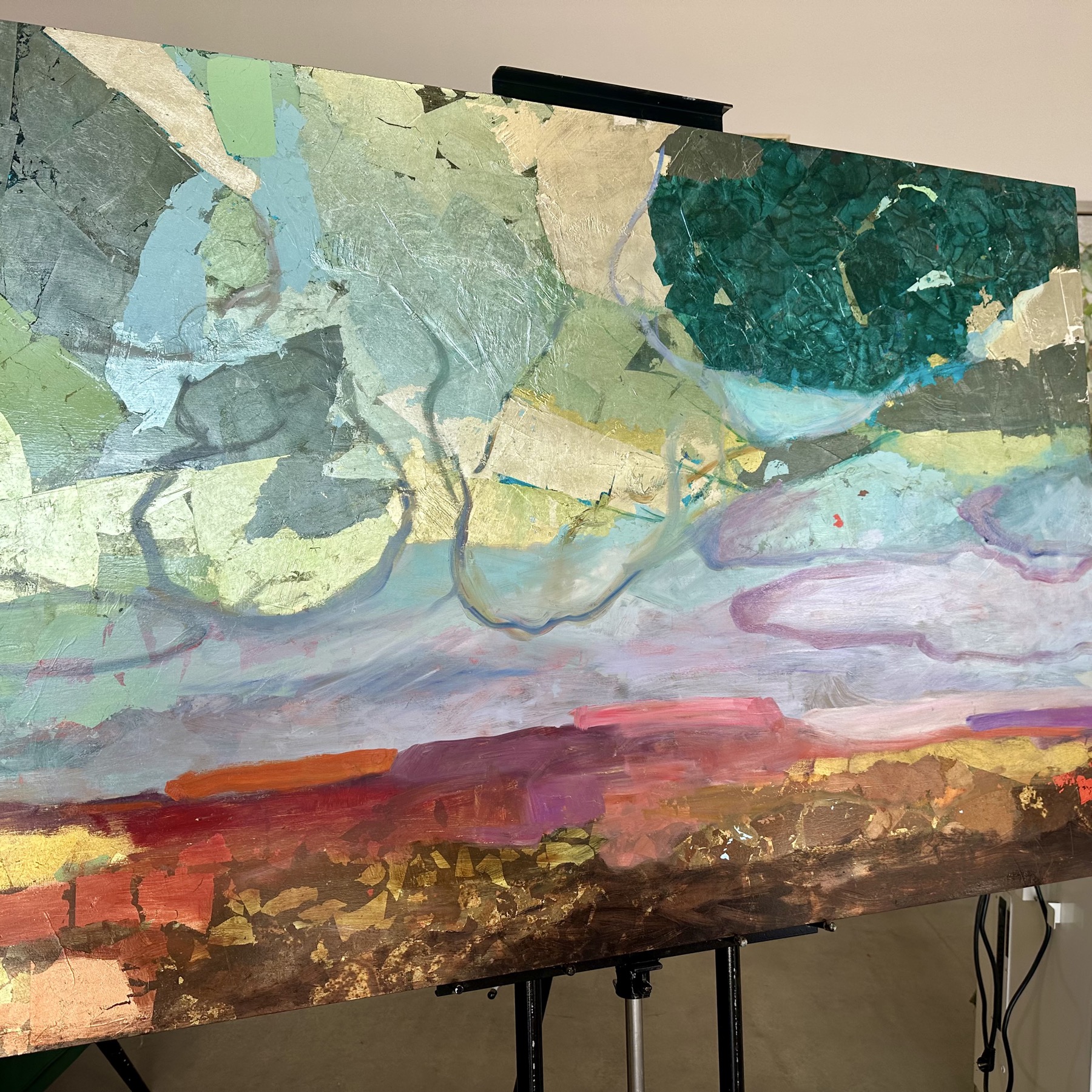
Paint overlays the leaf. Edges dissolve. The flat and angular elements of the composition become disrupted rather than reinforced.
Turning Point
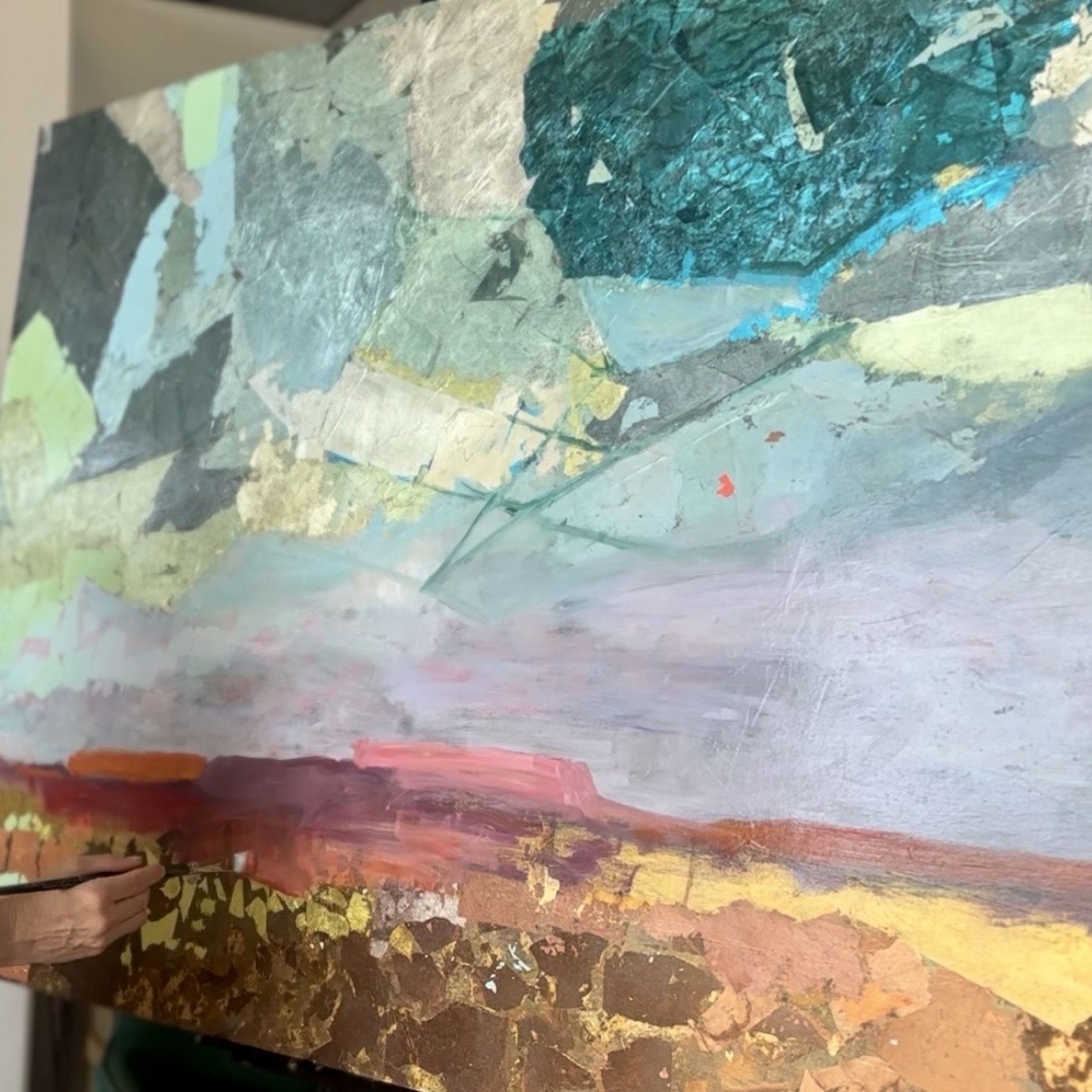
This is the first full interruption of the original structure. Paint overtakes leaf, breaking the continuity of the initial plan.
Integration
The original structure still held at the beginning of this chapter.
It was legible. It was controlled.
Painting over the leaf did not destroy my attachment to the original plan — but it loosened it.
The surface shifted from declarative to layered.
The painting began to operate in layers rather than in outline. And with different edges in place, the piece began to breath. The first hint of atmosphere.
Painting over the leaf changed my relationship to the painting and my ability to see.For the first time, I allowed myself not to know.
Horizon
III — Enjoying the Becoming
IV — The Shape Emerges
I don’t see the whole image.
But I like it.
That alone is different.
The composition has been broken into and there is something new- spaciousness - emerging.
The original shapes no longer dominate.
I enter the studio with lightness and openness.
I begin to see what shapes are already there.
A section of sky begins to reorganize.
I see where clouds could go. I layer new leaf over paint.
From
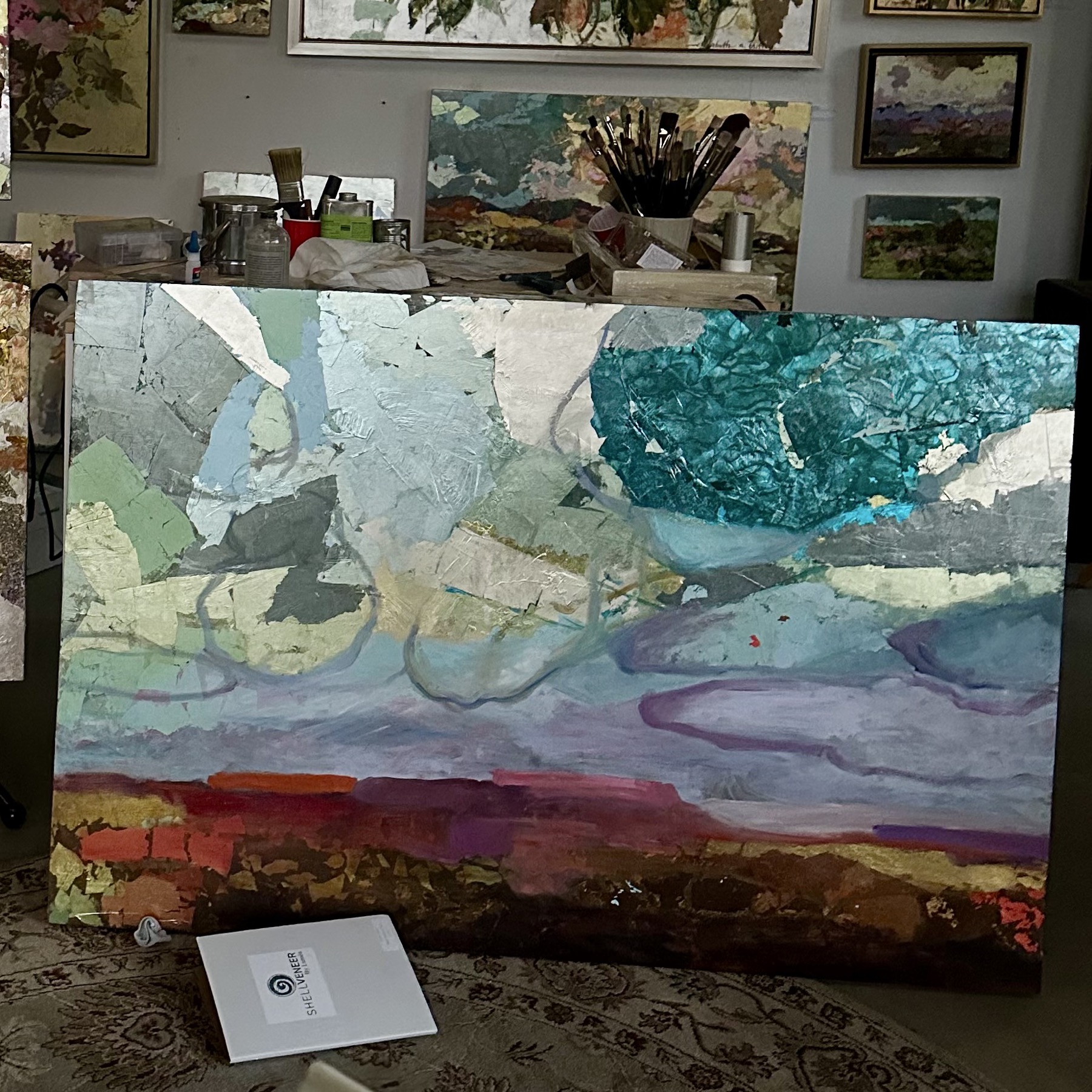
The surface is layered but unresolved. The sky still reflects earlier angular shapes.
Toward
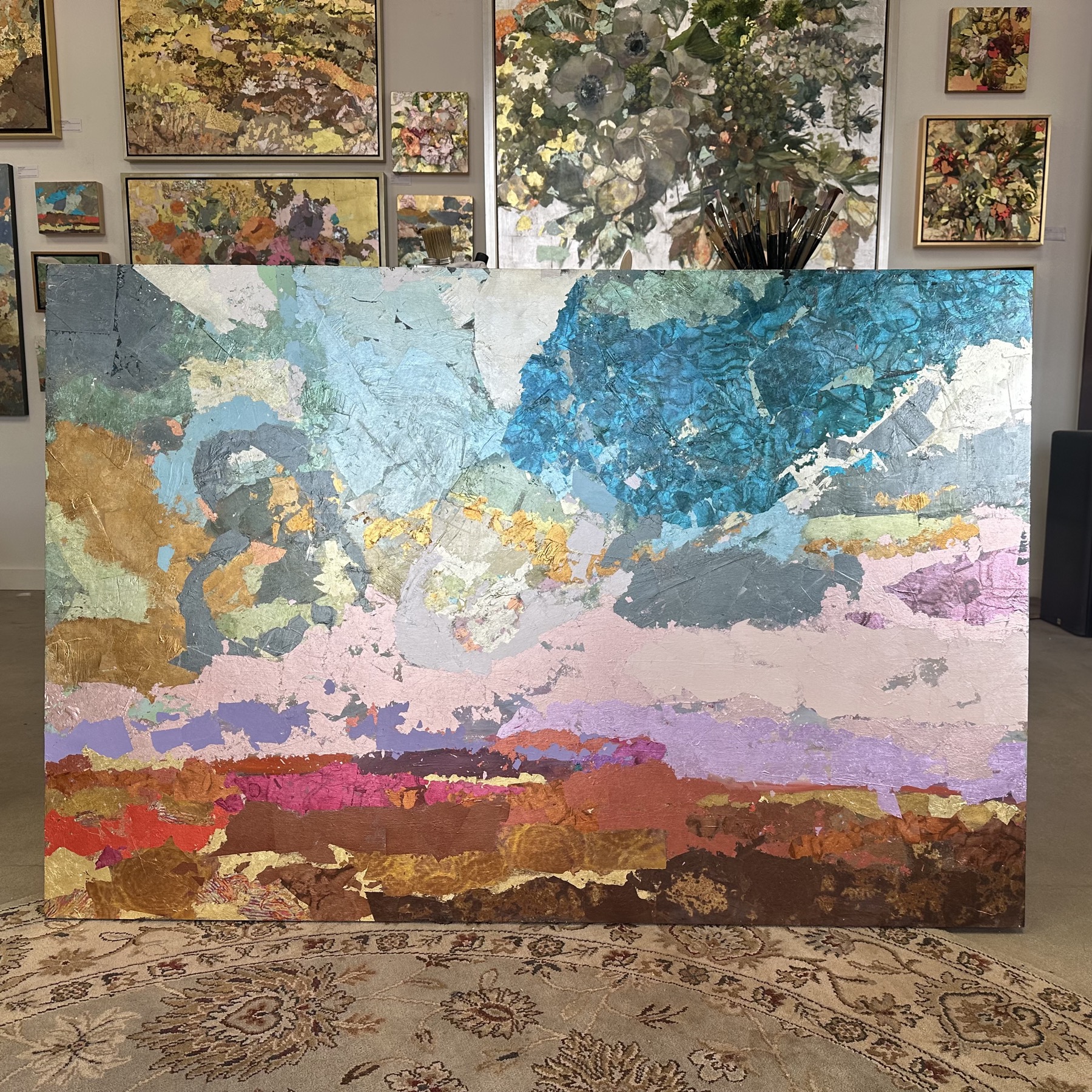
I leaf back over the paint almost entirely. Pink and lavender enter into the sky and soften the color palette.
Turning Point
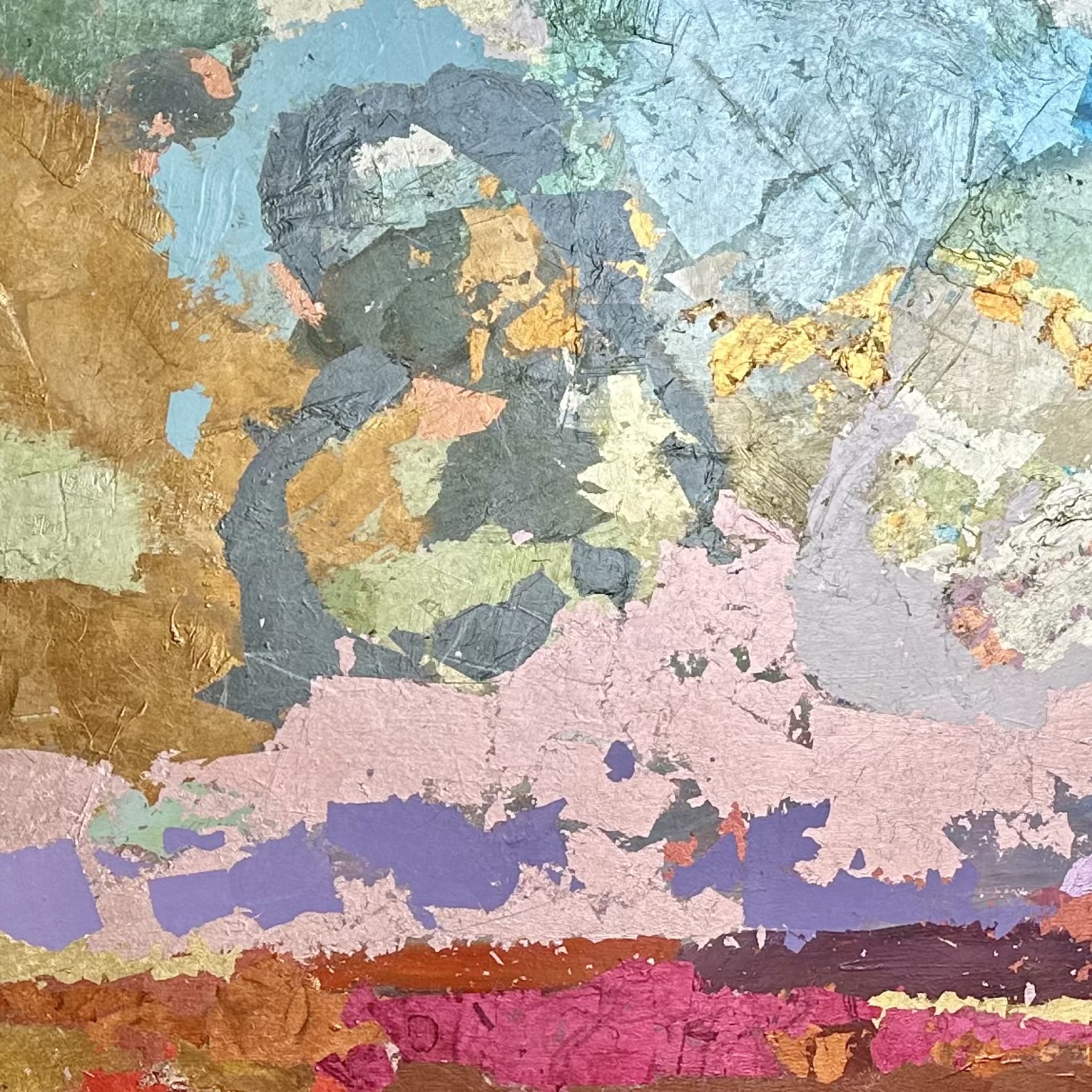
The long-held zig-zag sky division is broken up with smaller shapes of gold, pink, lavender, and yellow green. As the hard shape dissolves, a circular form emerges within the composition.
Integration
Liking it changed everything.
Liking it widened my field of vision.When I stopped trying to correct it, I could finally see it.
Not because it was solved.
But because I had loosened enough of the original idea to enjoy what it was becoming. This allowed me to see what I couldn’t see before.
Shapes that were already working. New colors that needed to be added.
Reintroducing leaf in smaller, broken shapes with softer colors changed the entire color story and feel of the piece.
Breaking the zig-zag shape softened and opened the sky.
The circle that emerged was not planned.It was visible because I was no longer defending the original structure.
The composition shifted from bold, angular divisions toward smaller, softer, layered patchwork.
For the first time, the sky began to organize itself around layered color and curves rather than edge, around my natural voice instead of a forced one.
Horizon
IV — The Shape Emerges
V — The Blue Returns
After waiting and working, and reworking the surface, the original color relationship reappears.
Cobalt blue returns against red earth — but not in the same form.
The composition has already been broken and rebuilt once. The large shapes remain, but their authority has softened.
I spend time looking before touching it.
What had once felt lost begins to feel possible again.
When the blue re-enters, it does not dominate.
It integrates. And new inspiration drops in.
From
Softer shapes, ambiguity in the center where the clouds meet. The surface carries pinks and muted, sweet transitions. The earlier red–blue contrast has been covered.
Toward
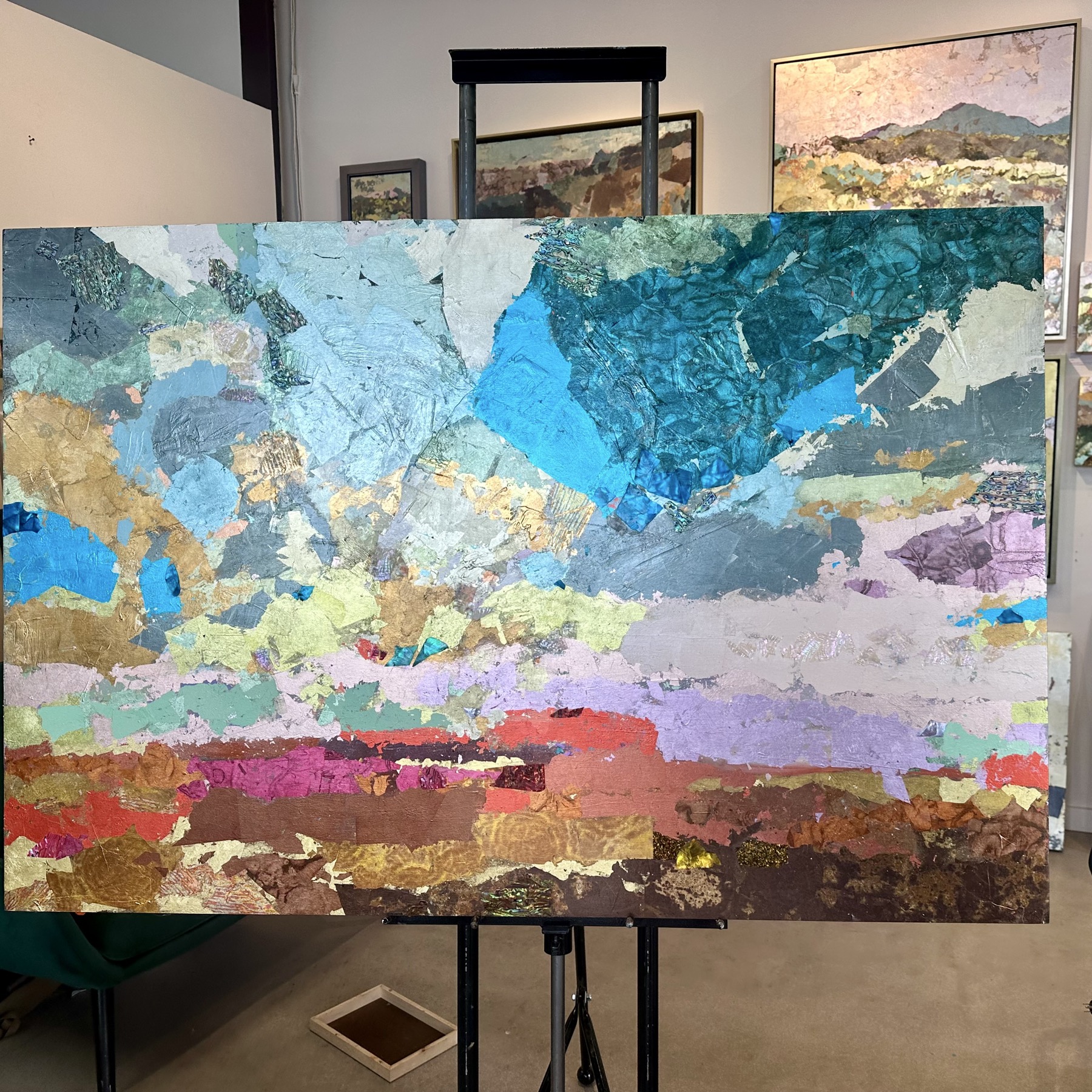
Cobalt blue and red re-enter in new shapes. Hard contrast returns, but softened by transitional tones. Green overlays where pink once was, and the colors begin to vibrate instead of dissipate.
Depth increases.
The sky opens without force.
Turning Point
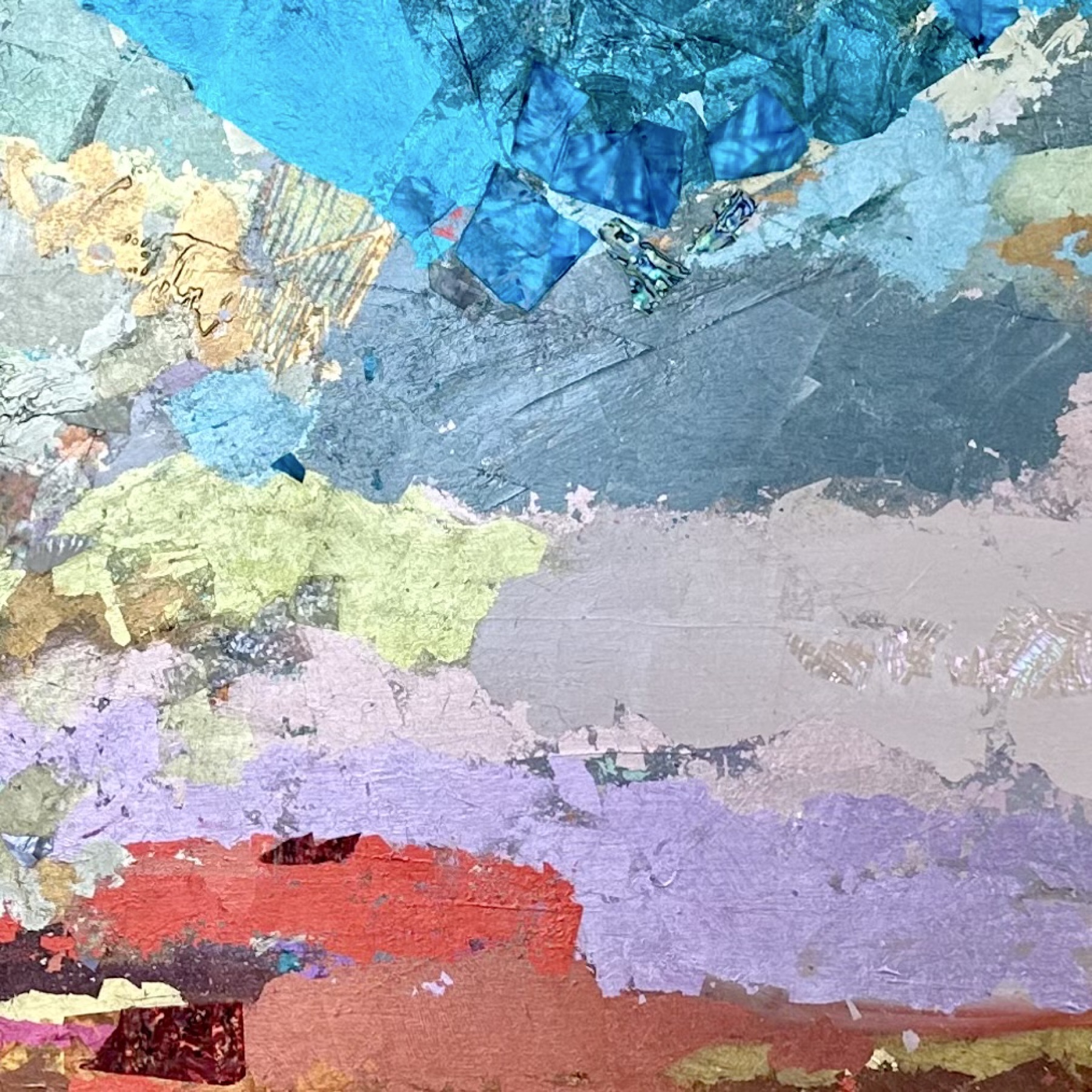
Blue is reintroduced — and blue mother of pearl - added texture- follows. The composition recalibrates around contrast and depth.
Integration
At this stage, the painting had arrived.
Not at completion — but at coherence.
The original impulse — cobalt against red earth — returned.But I was seeing differently now.
Contrast no longer needed to be forced.Impact no longer relied on geometry alone.
Transitional tones — colors I hadn’t originally envisioned — created the atmosphere that had been missing. Depth entered quietly.
The horizon became visible rather than implied.
Adding mother of pearl shifted the surface from flat declaration to layered presence. The intensity remained, but insistence softened.
For the first time, the painting felt internally logical.
I was still oriented toward finishing — but it was no longer a problem to solve.
It was holding.
Over the next week, I continued layering leaf, paint, and mother of pearl in the same rhythm. A small section of striated brass leaf entered near the center — an area that had carried visual confusion and unresolved weight from the beginning.
At the time, it felt subtle. Almost incidental.
I didn’t yet know how important it would become.
Horizon
V — The Blue Returns
VI — The False Finish
The horizon line is clarified.
Red pink earth meets the sky with greater precision. Directionality in the sky consolidates into more billowy shapes directing centrally and downward. Contrast increases. The center remains undefined and unclear.
After revisiting blue and mother of pearl, I return again to paper — a material I had previously tested and removed.
This time, with full conviction.
From
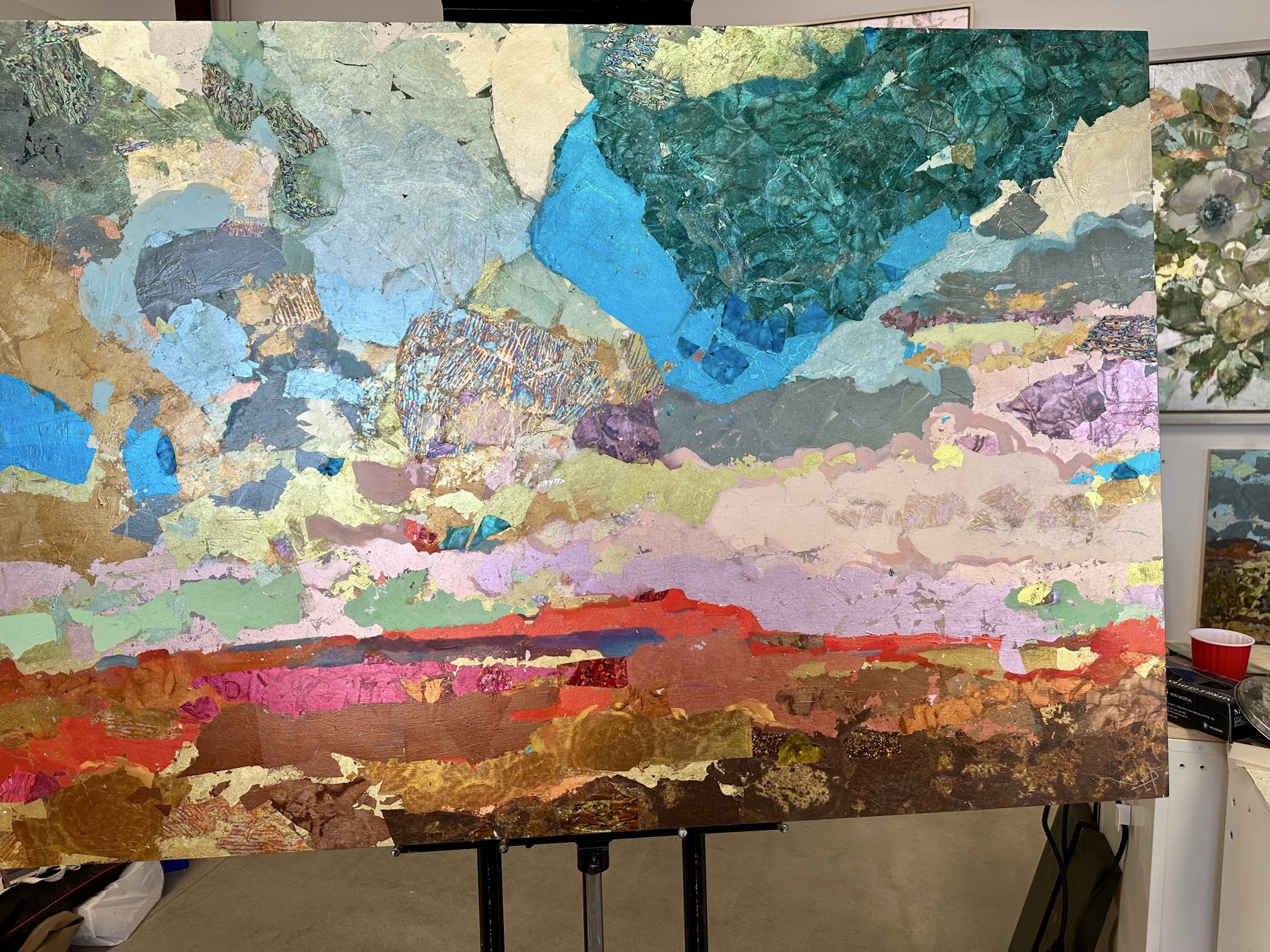
The horizon edge is refined. Blue and red are integrated. The sky reads clearly against the earth. Directionality is established.
Toward
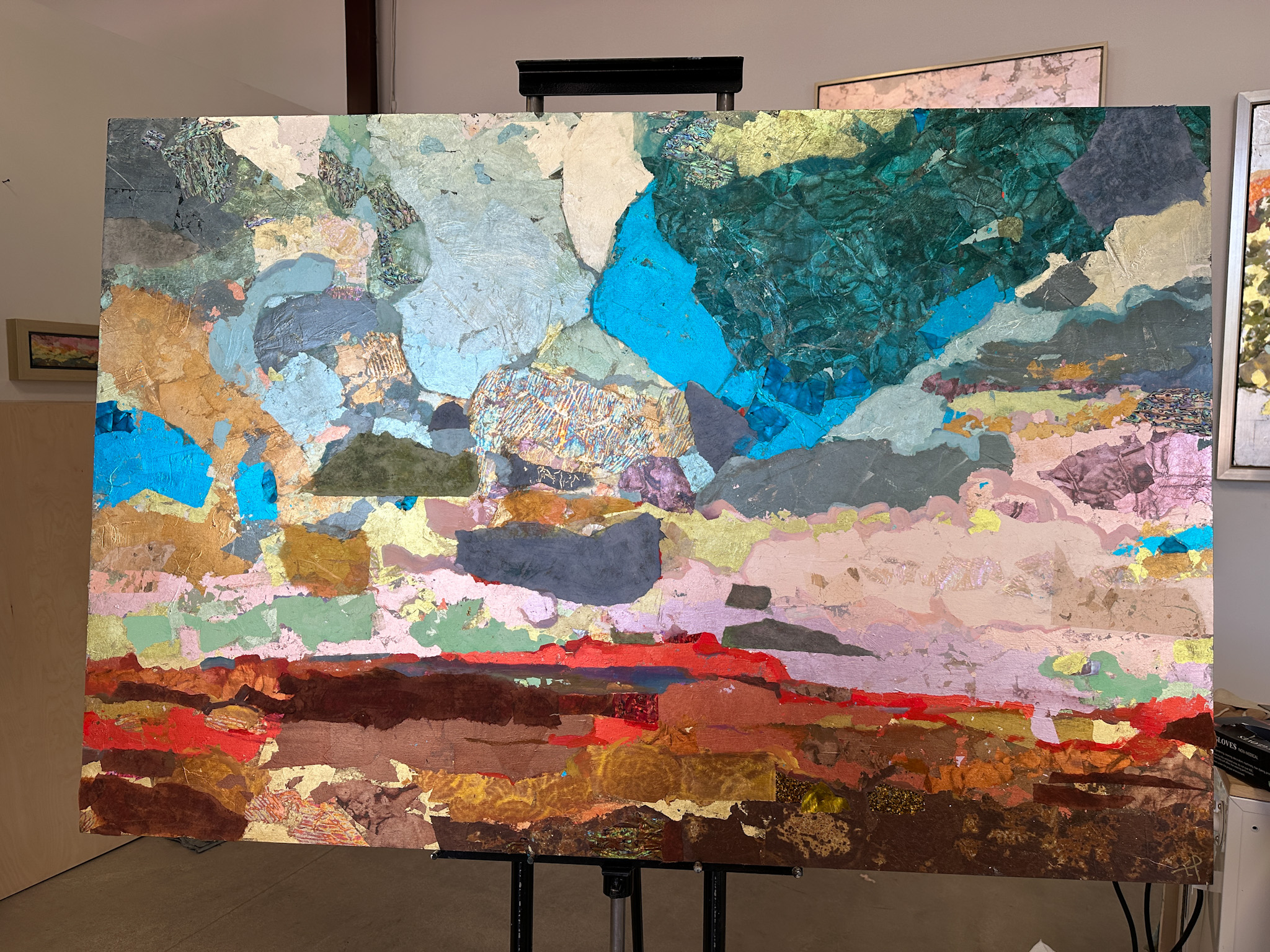
Paper introduces dark, bold shapes. Contrast increases. The surface becomes more segmented and graphic.
Turning Point
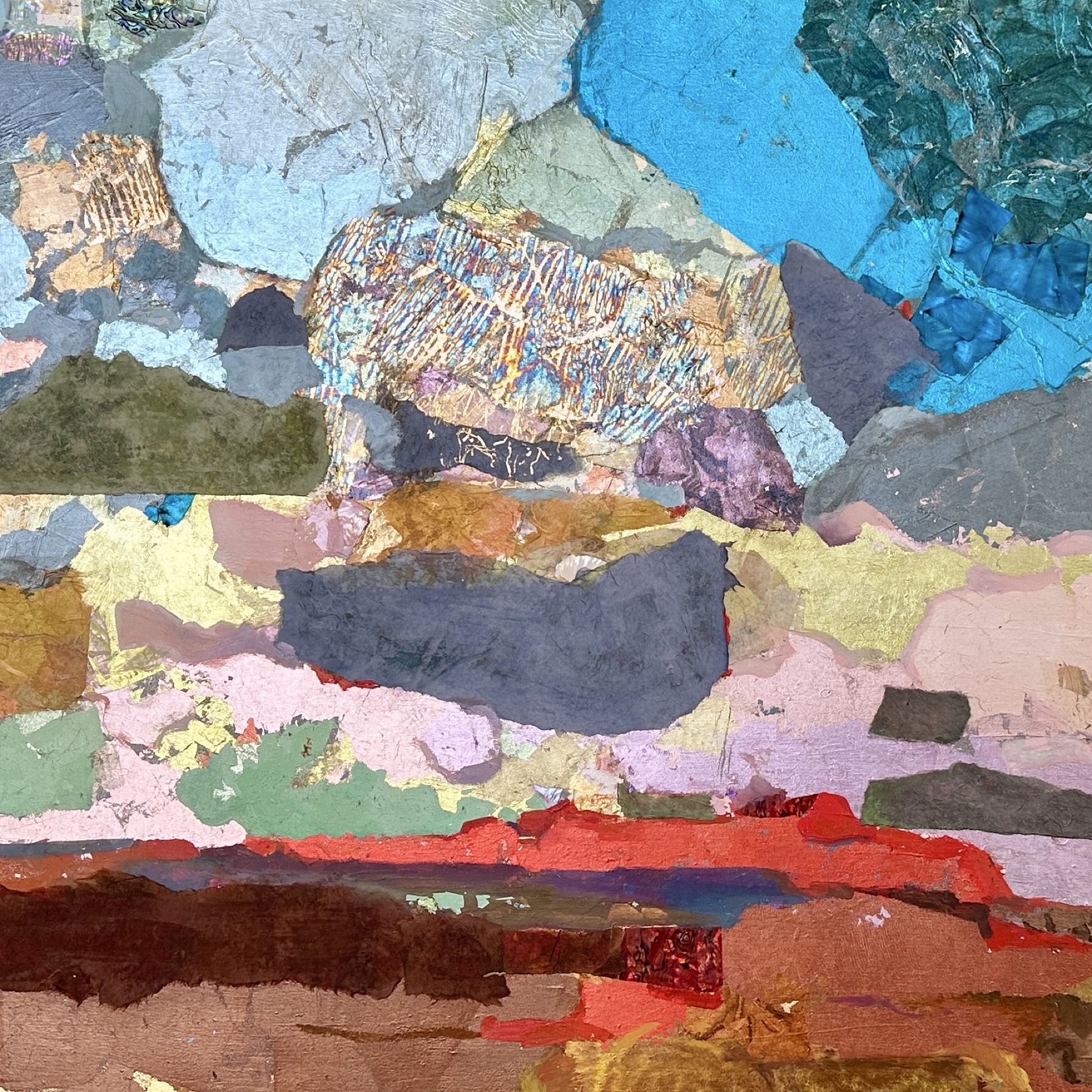
A striped leaf element enters near the center. Texture and linear variation begin to play a more dominant role.
Integration
This stage brought clarity — but not resolution.
The center of the composition had resisted me from the beginning. I introduced paper around it to try to help resolve and clarify what I couldn’t see. I added more mother or pearl elements to define it.
The dark forms increased contrast. They made the composition feel decisive.
But they also made it awkward.
I was trying to solve something I didn’t yet have vision for.
The paper didn’t open the painting.It imposed structure where I lacked sight.
I wrote a love letter to the painting here, declaring it finished.
Looking back, that letter marked relief — not completion.
Relief narrowed my perception.
I couldn’t see anymore so I called it done.
The composition looked resolved in parts — but the center felt forced. The tension had not dissolved.
Somewhere, I knew that.
Two days later, I declared it unfinished — indefinitely — and left it alone until clarity returned
Horizon
VI — The False Finish
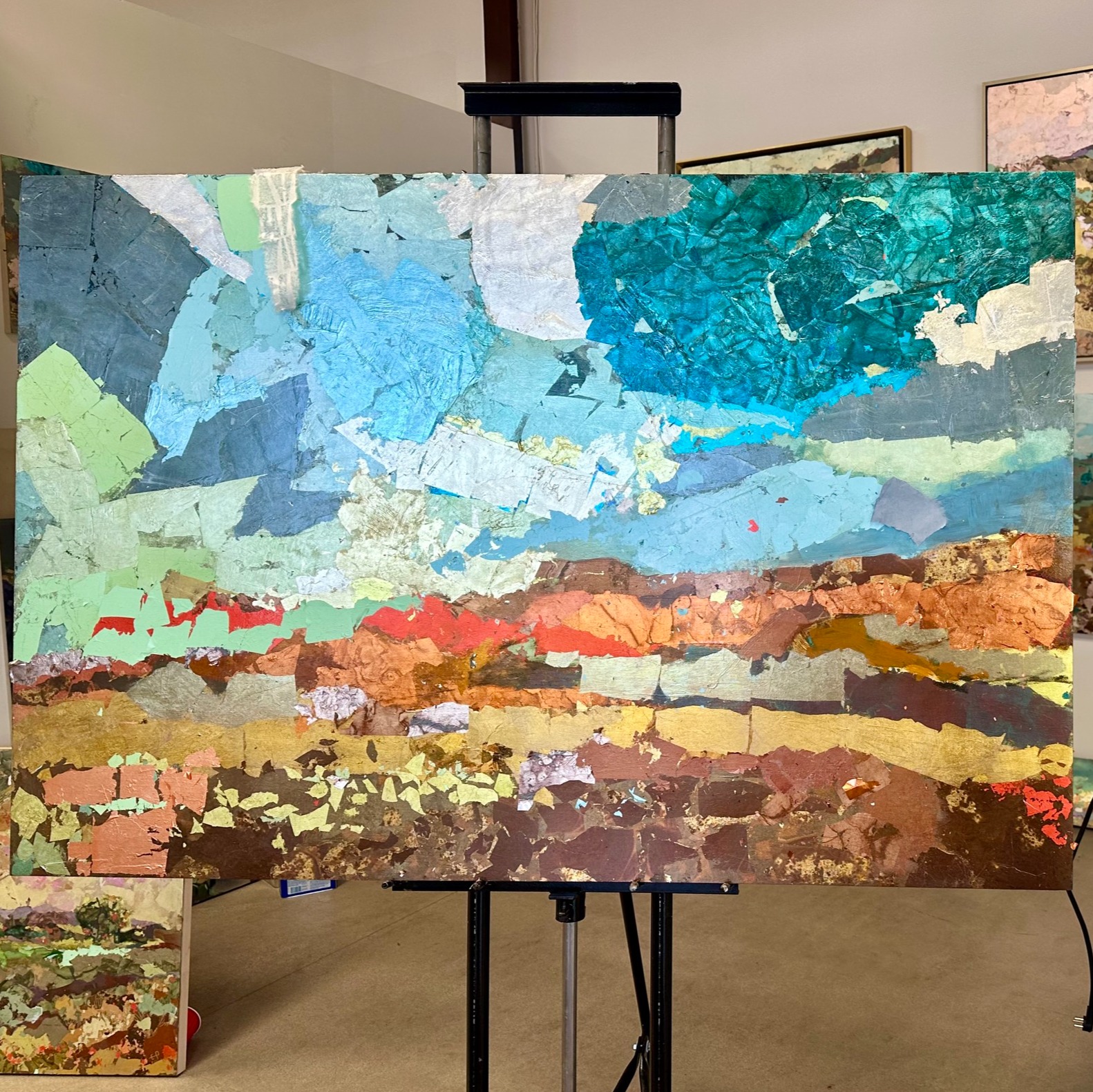
VII — Resolution
After two months away from the piece, I walk into the studio knowing it will be completed and it was going to be because of a variegated striated brass leaf.
In a single session — extended into two days — decisive changes are made.
Paper is covered with leaf.
The striated brass leaf, previously introduced in a small area, expands across the surface.
Blue intensifies. Hard geometry dissolves.
The horizon line destabilizes.
The painting moves from constructed landscape to atmospheric field.
From
The composition at this stage is layered and complex. Dark paper shapes float awkwardly around the center of the piece. Geometry remains visible and the horizon line is sharp and clean. It reads unresolved.
Toward
Paper shapes are covered by leaf. Mother of Pearl is covered by blue-green leaf. Striated brass expands. Red accents land. Blue intensifies. Hard lines dissolve. Patterns merge. The horizon becomes ambiguous.
Turning Point
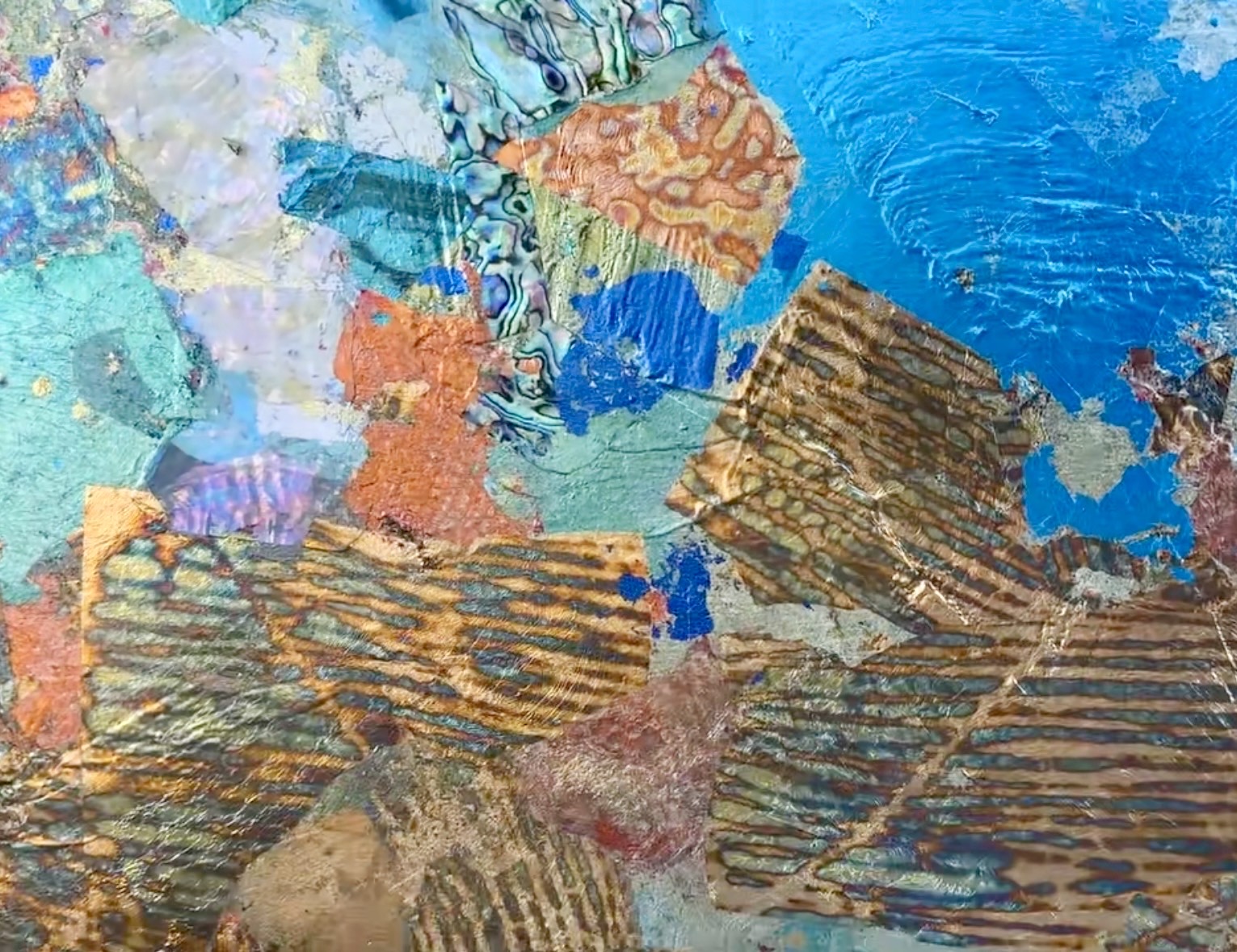
The striated brass leaf expands across the sky, covering paper and integrating with the patterns of mother of pearl, abalone shell, blue leaf, and brass.
Integration
Completion did not arrive through force.
It arrived through clarity.
I walked into the studio knowing only one thing:the variegated brass leaf that had been introduced in a small section needed to expand.
Not because I had planned it.Not because I had solved it intellectually.But because I could finally see it.
That leaf had always held something alive.
A collector saw it. I saw her seeing it. And my perception widened.
To let it expand meant covering parts of the painting I had protected for months — areas I thought were essential.
This time, I was not protecting them.
The move was decisive, but calm.
Geometry dissolved.The horizon destabilized.Sky and land began to merge.
The painting did not resolve because I controlled it.
It resolved because I was no longer defending it.
Distance and detachment had restored my sight.
What remained was bold — but atmospheric.Structured — but unforced.Complex — but coherent.
It held itself.
Horizon
VII — Resolution
Closing Reflection -
Grounded Into the Infinite
This piece began with certainty.
I had a clear plan. A strong structure. A defined outcome in mind.
And when it didn’t resolve the way I expected, I tightened.
My field of vision narrowed.
I tried to force clarity.
And the painting stalled.
What Horizon showed me is this:
Certainty can constrict perception.
Attachment can distort sight.
Time restores vision.
Every layer that felt like a detour was actually preparation.
Every pause widened my ability to see.
The final surface — the cobalt, the red, the grounded horizon — did not arrive because I executed a plan correctly.
It arrived because I released my grip long enough to see what was already there.
This is how I work.
I declare structure.
I follow inspiration.
I lose clarity.
I create distance.
I return.
I recalibrate.
I stop when the work holds without force.
Grounded Into the Infinite is not about control.
It is about trusting that the solution exists — even when I cannot yet see it.
Watch the making of
Horizon
The entire process — from first mark to final surface — distilled into four minutes.
You're part of this
The work doesn't happen in isolation — what you notice becomes part of how it evolves. Tell me what's moving you, what a piece opened up, what you're sitting with. I read every one, and they shape what comes next.